
Interceptive Orthodontics
Straight, aligned teeth and jaws promote better oral health in children. Crooked, misaligned smiles can be more challenging to keep clean, sustain dental damage and lead to oral health concerns in the future.
KidsSmile Paediatric Dental agrees with Orthodontics Australia's recommendation that kids should have an orthodontic assessment between ages seven and 10. We invite you to contact us for an orthodontic evaluation at our Broadmeadow or Maitland dental surgery.
What Is Interceptive Orthodontics?
Interceptive orthodontics is also known as early orthodontic treatment or two-phase orthodontic treatment. This treatment aims to direct a child's growth and development to correct or prevent certain types of malocclusion (issues with the position, size or spacing of the teeth and jaws). For example, kids with a severe overbite or underbite might require more complex treatment as an adult, like oral surgery. However, early orthodontic treatment allows us to intercept and correct the problem before it progresses.
When Does Treatment Begin?
First, our paediatric dentists in Broadmeadow will determine if your child is a candidate for early orthodontic treatment. We will create a detailed treatment strategy based on their specific needs if they are. Treatment timelines vary based on the patient. However, early treatment, also known as Phase One, usually begins around age eight or nine; Phase Two starts around age 11 or older.
The Benefits of Interceptive Orthodontics
When little ones visit our dental clinic, Drs Helen, Will or Niv will sit down with you and walk you through their findings using x-rays and digital images. Our team always takes the time to explain your child's case and treatment needs in detail, weigh the pros and cons of treatment and answer any of your questions.
Interceptive orthodontics can do the following for your child:
- Shift protruding teeth, thus minimising trauma risk
- Make future treatment quicker, easier and more affordable
- Avoid the need for extractions or surgery in the future
- Make space for adult teeth to emerge in the proper position
- Prevent tooth impaction, crowding and irregular eruption of teeth
- Boost kids' self-esteem and confidence
Our Early Orthodontic Treatments 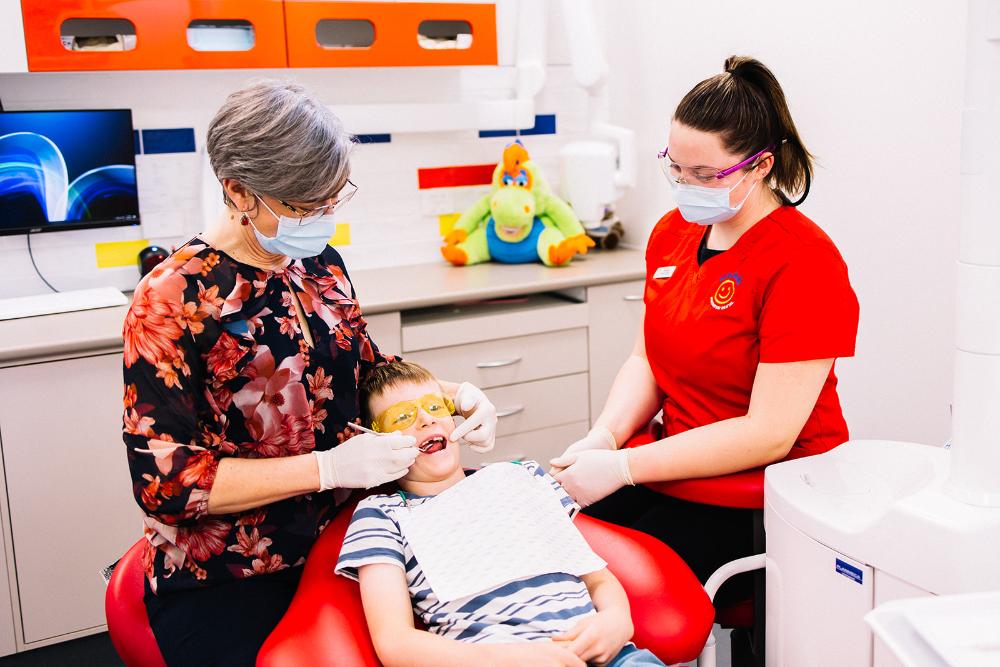
KidsSmile Paediatric Dental offers different methods for early orthodontia.
1. Space Maintainer Appliances
Space maintainers have a long history in paediatric dentistry across the globe. Their use aims to minimise or prevent arch length loss due to a baby tooth's premature loss. They may be in the form of a band with a loop or two bands and a wire in the palate (roof of the mouth) or along the inner aspect of the lower teeth (lingual arch). They aim to remain passively in place until the eruption of permanent teeth.
2. Removable Appliances
These may be used to correct cross-bites and minor anomalies to protect the permanent dentition.
3. Care of Your Child’s Mouth during Orthodontic Treatment
Whether your child is having care with an orthodontist or the KidsSmile Team, regular monitoring of their oral health is important. Six monthly checks are a good baseline, however if your child has had an oral trauma monitoring may need to be more regular.
Cleaning, Care and Maintenance of Space Maintainers
Space maintainers are cemented to the teeth but may become de-bonded particularly with hard or sticky food (muesli bars, toffees, sticky lollies). Teeth with space maintainers still need thorough brushing and flossing to maintain their health. Teeth should have radiographs (x-rays) at least every two years to monitor the developing adult tooth.